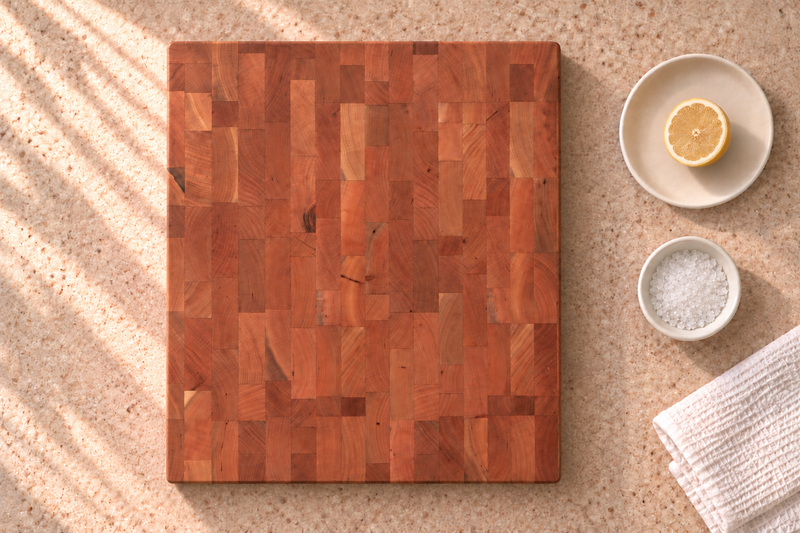
Make Both Sides of a Board Useful
Use the grooved face for juicy foods and the flat side for chopping or serving. A few simple habits help you keep both faces clean and ready for their next job.
Grooved face
Flat reverse
Give each face a useful role, clean according to the food it touched and keep a separate board for raw meat, poultry, fish and seafood.
Get to know both faces
A reversible board is made to be used on both sides. Some have one grooved face and one flat face; on others, the two are similar. Look at the feet, handles and shape to see how each side will work for you.
Having two surfaces in one board is handy when cupboard space is limited. You can switch between everyday chopping and serving while keeping separate boards for raw and ready-to-eat foods.


Choose a face for the task, and keep a separate board for raw foods.
For juicy foods or easy ingredient transfer
If the board has a juice groove on one face, use it for juicy fruit or carving cooked food. Choose the flat face when you want an open surface for chopping vegetables and gathering them into a bowl.
Before flipping, check the underside. If it has touched a dirty counter or runoff, clean it before putting food on it.
For prep and serving
You can do most chopping on one face and save the other for bread, cheese or small bites. That can leave a less-marked side for the table, though both faces will show use over time.

Clean the serving face according to the foods it held. Carry a loaded board with both hands and arrange bowls or slippery foods so they stay steady. A handle doesn’t make every load safe to carry one-handed.
Keep raw foods on a separate board
Assigning raw meat to one face and salad to the other is not a replacement for separate boards. Liquids, hands, the knife and the counter can transfer contamination while you handle and flip it.
Health Canada recommends a separate board for raw meat, fish and poultry from the one used for ready-to-eat foods. Keep that rule in the setup, regardless of reversibility. Our raw-food guide explains the wider routine.
Give the underside some attention
When washing is needed, briefly wash and rinse both faces and every edge without soaking or saturating the wood. Towel-dry all sides right away and let air reach both faces, away from direct heat. Wait until the board is dry before resting it flat on the counter.
Look at the face that usually sits underneath. Check for trapped moisture, residue, cracks or a joint opening. Condition the entire clean, dry board when needed. A useful two-sided routine includes care for the hidden surface as well as the one you see.