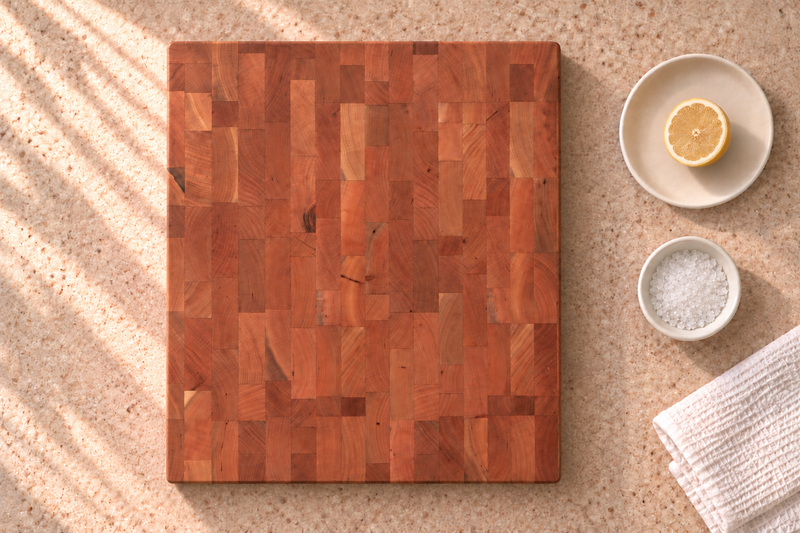
Board Thickness and Everyday Comfort
A thicker board raises your cutting surface. Check how that feels at your counter, then make sure you can lift, wash and store it comfortably.

Check the final working height and the whole lifting, cleanup and storage route before choosing a thick board.
Measure the height you will work at
The board sits on top of the counter, so its thickness adds directly to your working height. A 1¾-inch board places the cutting surface 1 inch higher than a ¾-inch board on the same counter. Include any feet or support mat in the calculation.
That extra inch can feel helpful on a low counter or awkward on one that already feels high. Notice whether your shoulders rise, your wrist bends or you reach away from your body during ordinary preparation. CCOHS recommends matching the work surface to the person and the task. There is no single ideal board thickness for every kitchen.
Try the height without a knife
Before buying, place a stable stack of flat material on the counter to approximate the thickness. Keep sharp tools away from this mock-up. Stand where you normally cook and imitate a few slow preparation motions with empty hands.
Check the position of your elbows and shoulders. Repeat the test at the lower height. If another person cooks regularly, ask them to try too. Use this test to compare comfort at different heights. If kitchen work causes pain, seek appropriate advice rather than expecting a board to solve it.
Give your hands access to the board
A thicker board may offer more edge to hold, yet its weight can make a cramped grip awkward. A recessed handhold only helps when you can reach it. Leave clearance between the board and the backsplash, appliance or wall beside it.
Thickness contributes to weight, but species and construction also affect mass. Check that you can lift and turn the board securely for cleanup and underside inspection. A manageable everyday board may suit a kitchen that must be cleared frequently better than a substantial block with no practical handling route.
Follow the route from counter to storage
Use these checks before settling on a size:
- Counter: enough room for the board, your hands and the food beside it.
- Sink: clearance to turn the board and rinse it under the faucet.
- Drying place: a secure support with airflow around both faces.
- Storage: enough space for the full thickness, including feet or handles.
A permanent counter position still needs a cleaning and inspection routine. Avoid choosing a block you cannot lift or move when that care requires it. Our weight guide and size guide help you assess the remaining measurements.
Thickness is one part of a comfortable setup. A board earns its place when the working height feels natural, your hands can grip it securely and the care routine remains manageable after an ordinary meal.