How Much Board Weight Is Comfortable?
The right weight feels manageable from prep through cleanup. Compare lighter boards and substantial blocks, including the space you need to lift and turn them.

Choose a weight that everyone using the board can lift and turn comfortably, with room to clean and dry underneath.
How much do the boards weigh?
A thinner board can be easier to take out each day; a heavier block can suit a dedicated place on the counter. Compare the weights below with something you already lift comfortably.
The shape and grips matter too. A broad board can feel different from a compact object of the same weight, especially when you turn it for cleanup.

Grooved maple board
16″ × 12″ · 3.5 lb (1.6 kg)

Grooved maple board
20″ × 14″ · 5.3 lb (2.4 kg)

Maple edge-grain block
20″ × 16″ · 12.8 lb (5.8 kg)
Consider the whole trip from counter to sink to storage. Check handling with the board empty and dry.
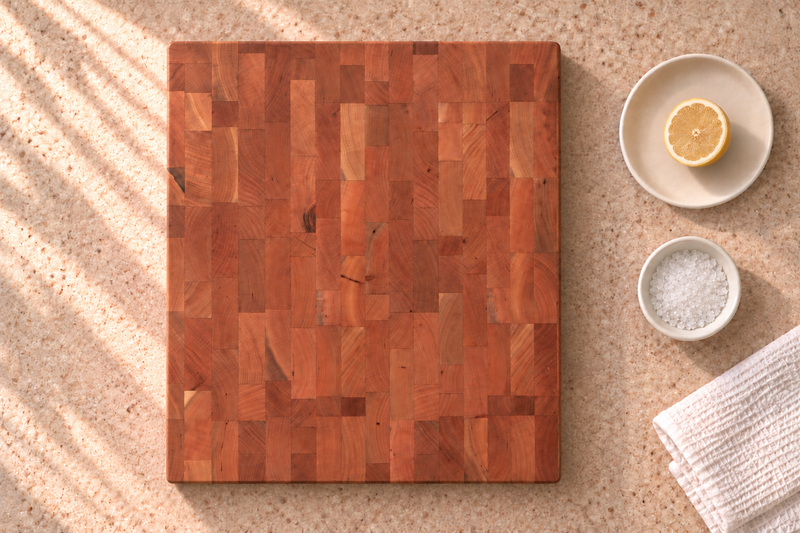
For comparison, the cherry end-grain block weighs 11.9 lb (5.4 kg), and the maple-and-birch end-grain block weighs 12.8 lb (5.8 kg). A groove reduces the flat cutting area within a board’s overall dimensions.
Think about the complete movement
Think through each step after cooking: lifting the board, turning it at the sink, reaching the reverse and setting it up to dry. Leave enough room for your hands throughout.
Use a familiar dry object as a rough guide to the weight. Don’t test yourself with wet hands or a makeshift heavy load. If you’re unsure you can handle the board comfortably, choose a lighter size.
Weight does not replace a stability check
A heavy board may feel planted, but a slick counter or uneven surface can still make it move. Before cutting, check the setup with empty hands. The board should not slide or rock.
Use a suitable nonslip support if needed. Afterward, remove a damp towel or mat and let the board and support dry separately. Check underneath between uses.
Consider everyone who uses the kitchen
The person doing the chopping may not be the person doing cleanup. Choose a board that the regular users can handle comfortably. Integrated hand grips give your hands a convenient hold for lifting and turning.
A lighter board may be a better choice when reach, grip or hand comfort makes a block awkward. Leave space around any board kept on the counter so everyone who uses it can manage the cleanup.
Choose what works through the whole meal
Choose a substantial block for a generous, dedicated prep station. Choose a lighter daily board when you often clear the counter or carry food to the table.
A useful board brings together the working area, construction and weight that suit your kitchen. Start with the fit test, then choose a weight that still feels manageable at cleanup time.