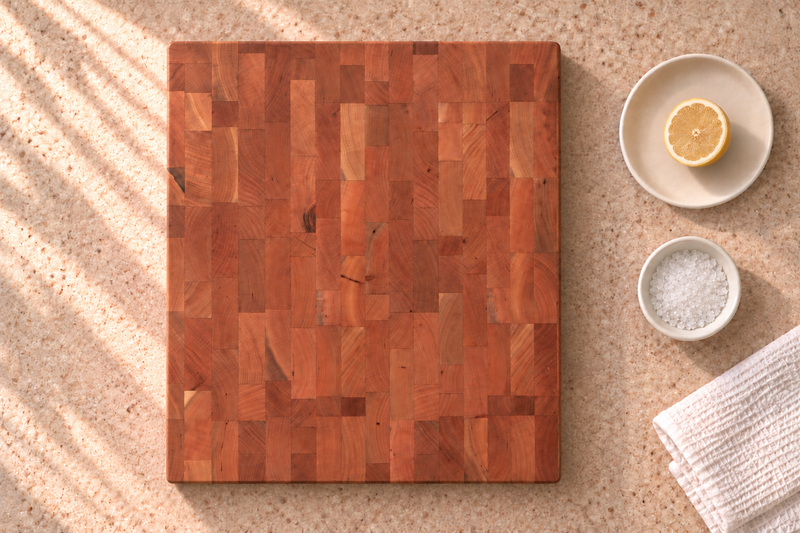
Dry or Damaged? Read the Signs
Does your board need oil, a light surface refresh or a closer look? Start with clean, dry wood and let its condition guide the next step.
Oil can condition a dry surface when its finish allows it. Roughness, movement, open joints and deep damage need separate assessment.
Make a short inspection
Assess the board on a clean, dry surface when the wood itself is clean and fully dry. Remove loose dry debris with a brush or cloth. Deal appropriately with food residue or contamination, but do not wash an already clean board just to inspect it.
Put the knife away and set the clean, dry board on a flat counter. Gently press each corner to check for rocking or a gap underneath. Look at the texture before touching it, and keep your hands away from splinters. Photograph new gaps or cracks so you can show the seller what changed.
Pale and smooth: check the care routine
A smooth, matte surface that looks lighter than before may need conditioning. Natural variations in the wood and lighting can also make it look pale. Check whether the board’s finish is intended for oil care.
For an oiled, unvarnished board, follow its directions with food-grade mineral oil made for food-contact wood. Apply it only when the board is clean and fully dry. Treat the faces and edges as directed, then remove excess oil. Do not sand a smooth surface just to make its colour deeper. Our oiling guide covers the signs to watch.

Rough or fuzzy: inspect the texture
Light surface fibres can rise after contact with water. Check again when the board is dry. Oil may deepen the colour while leaving the rough texture in place.
If the board is structurally sound and its manufacturer allows sanding, a light surface refresh may help. Stop if the roughness includes splinters, crumbling wood or a gap that catches residue. Those conditions need more than a cosmetic pass. Our sanding guide sets out the limits of small maintenance work.
Rocking or curved: pause knife work
If the board rocks or leaves a gap underneath, stop cutting and ask for advice. Wood exchanges moisture with the surrounding air, and uneven wetting or drying can contribute to movement.
Let both faces have airflow at normal room conditions, away from a radiator or direct heat. Review how the board was washed and stored. Do not soak it, bake it, clamp it or otherwise force it flat. If the board remains distorted, contact the seller with photos. Drying may change the condition, but it does not guarantee a flat board.
Open joints or deep damage: stop food use
An open glue joint, a growing crack or a deeply scored surface that is difficult to clean belongs in a different category. Stop using the board for food and ask for an assessment or replace it. Do the same if you see mould; do not try to rescue it by oiling or sanding. Never probe an opening with a blade or try to fill it with oil. A gap’s apparent depth cannot tell you whether it is safe for food use.
Keep photos and purchase details before modifying the board. A clear record helps the seller assess it. Our restore-or-replace guide explains the difference between a light surface refresh and damage that ends food use.
Choose the response that matches the symptom. A little oil, a small permitted surface refresh and retirement from food use are different decisions. Making that distinction preserves both the board and the confidence with which you use it.