Choose a Board That Works with Your Knife
A sharp knife needs a stable cutting surface and enough room to move. Check the material, usable space and everyday habits that help you stay in control.

Use a surface intended for cutting and keep it stable. Give the knife room to move, transfer food with a scraper and maintain the blade separately.
Choose a surface intended for cutting
A stone counter or decorative glass panel may look durable, but it is a poor substitute for a knife’s working surface. Knife maker WÜSTHOF warns that glass, metal and stone can dull an edge quickly. Use a board intended for repeated knife contact.
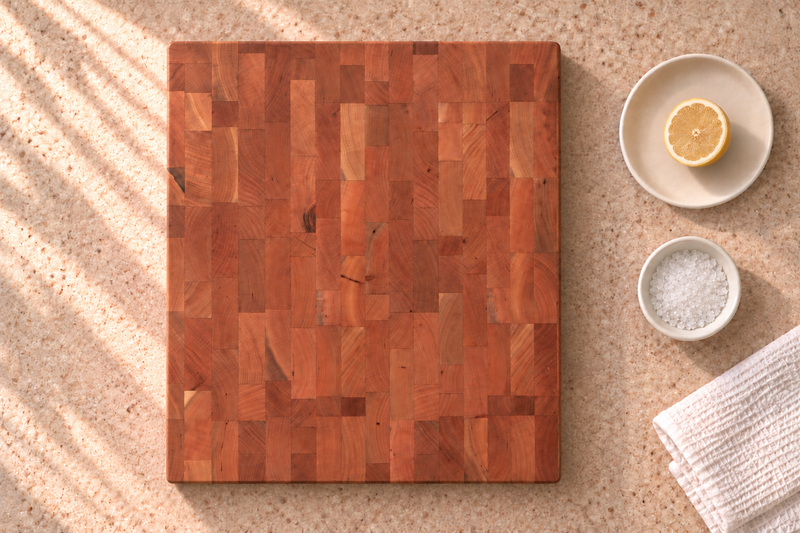
Both end-grain and edge-grain wooden boards can provide useful cutting surfaces. Grain orientation describes how the board is built, but does not promise a particular blade life. Compare the model’s size, condition and handling alongside its construction.
Our construction comparison explains what you can observe before buying.
Give the knife room to move
Match the working area to your usual ingredients and knife, not just the size of a single food item. A long bread knife needs room for its motion. A chef’s knife needs clear space around the ingredient and your supporting hand.
Keep bowls and scraps away from the path of the blade. Transfer finished food into a container rather than building a wall of chopped ingredients beside your hand. If the board is small, work in smaller batches instead of squeezing more onto it.
Check stability before picking up the knife. With the surface clean and dry, press gently on the board’s corners. Resolve rocking or sliding before use. Use support appropriate to the board and counter; do not build a wobbly stack to gain height.
16″ × 12″ × ¾″ · grooved maple
20″ × 14″ × ¾″ · grooved maple
Use a scraper to gather ingredients
Use a cutting motion appropriate to the food and the knife. Avoid twisting a blade sideways in a hard ingredient or using an ordinary chef’s knife to strike bones. Follow the knife maker’s limits for frozen foods and other demanding tasks.
Gather chopped food with a bench scraper rather than dragging the knife’s sharp edge sideways across the board.

If a knife slips, crushes food or needs more pressure than usual, stop and inspect the setup. The issue may involve the blade, the ingredient or the board’s movement. Seek sharpening guidance appropriate to that knife rather than trying to correct everything through force.
Maintain the pair separately
Clean food residue, grease and contamination effectively, with only the water exposure needed for the job. Dry promptly after damp cleaning and let air reach both faces. Have deep grooves or open joints assessed before further food use; oil cannot repair or sanitize them.
Follow the knife maker’s care instructions. Check that the handle is secure and store the blade safely. Use board oil for the wood and the appropriate sharpening method for the knife.
For the board’s marks, use our wear guide. Make changes when they improve control or make cleaning easier, rather than chasing an untouched appearance.
Choose a board that gives your knife room to work, stays stable and fits a cleanup routine you can manage.